What is happening
Resident Indians who own property abroad and have not reported it should expect income-tax notices in the coming weeks. According to a report in The Economic Times, an official of the Income-tax Department’s investigation wing indicated this to practitioners and auditors at a recent webinar.
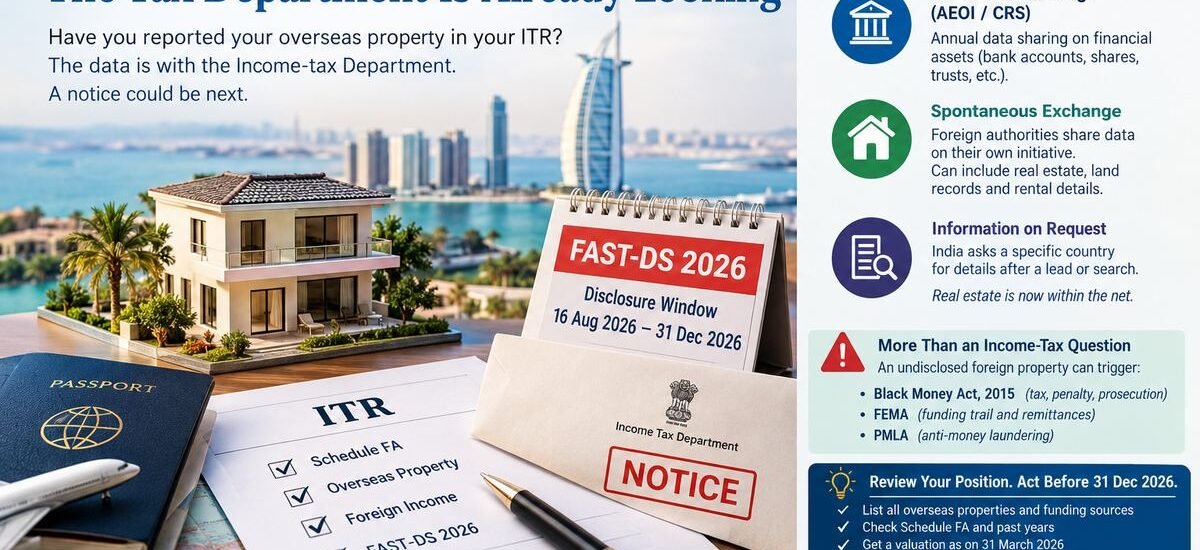
The department already holds the data. It has come in from several foreign jurisdictions, and earlier batches covered Indian-owned property in Dubai and other popular markets. Thousands of taxpayers have also received SMS reminders to report overseas assets in Schedule FA and to consider the FAST-DS 2026 disclosure window, which closes on 31 December 2026.
For anyone holding an overseas flat, villa or plot that is missing from their return, the question is no longer whether the department knows. It is what the taxpayer does before the notice arrives.
How the information reaches India
Many taxpayers assume that only foreign bank accounts are visible to Indian authorities. That is no longer a safe assumption. Three channels now work together:
| Channel | How it works | What it typically covers |
| Automatic exchange (AEOI / CRS) | Annual, routine data sharing between tax authorities under treaty | Financial assets: bank and custodial accounts, shareholdings, beneficial ownership of trusts |
| Spontaneous exchange | A foreign authority shares data on its own initiative when it believes India would find it relevant | Can include immovable property, land registry and rental records |
| Information on request | India asks a specific country for details after an enquiry or search reveals a lead | Case-specific: ownership, purchase price, funding trail |
The key point: automatic exchange is largely limited to financial assets, but the other two channels are not. Real estate abroad, long considered outside the net, is now reaching Indian tax officers through spontaneous exchange and targeted requests.
More than an income-tax question
An undisclosed overseas property can open three separate lines of enquiry. Fixing one does not close the others.
- Black Money Act, 2015. A resident who fails to report a foreign asset faces tax at 30% on its value, a penalty up to three times that tax, and a separate penalty of ₹10 lakh for non-disclosure in the return. Prosecution is also possible.
- FEMA. The department will look at how the purchase was funded. Was the money remitted under the Liberalised Remittance Scheme within its limits? Was a foreign loan or mortgage taken, creating an overseas liability? Was the property bought with funds that never left India through banking channels? Each answer carries its own FEMA consequence.
- PMLA. Where the source of funds cannot be explained satisfactorily, the matter can move into the anti-money-laundering framework.
As practitioners quoted in the report put it, reporting a property to the tax department does not cure a FEMA or PMLA breach. Any regularisation plan has to address the funding trail as well as the tax return.
FAST-DS 2026: the window open until 31 December
The Foreign Assets of Small Taxpayers – Disclosure Scheme, 2026 (FAST-DS) is a one-time voluntary scheme under Chapter IV of the Finance Act, 2026. It opened on 16 August 2026 and declarations must be filed online by 31 December 2026. A valid declaration gives immunity from tax, penalty and prosecution under the Black Money Act for the assets declared.
It offers two routes:
| Route 1: Undisclosed assets or income | Route 2: Tax-paid but unreported assets | |
| Who it suits | Foreign asset or income never offered to tax in India | Asset bought from income already taxed in India (e.g. LRS remittances), or acquired while a non-resident, but missed in Schedule FA |
| Value ceiling (as on 31 March 2026) | ₹1 crore aggregate | ₹5 crore |
| Amount payable | 30% tax + equal additional amount = 60% of value | Flat fee of ₹1 lakh |
A worked example. A resident bought a Dubai apartment in 2021 for the equivalent of ₹80 lakh, funded partly through LRS remittances from taxed income and partly from rent and savings abroad that were never reported in India. Its value on 31 March 2026 is ₹95 lakh. If the whole asset falls in Route 1, the outgo is ₹57 lakh (60% of ₹95 lakh). If the funding can be fully traced to taxed income, Route 2 may apply at ₹1 lakh. The difference rests entirely on documentation of the source of funds.
The scheme has limits. It does not cover proceeds of crime, cases where Black Money Act assessments are complete, and certain other excluded persons. Valuation rules for property, bank accounts and assets already sold also need care. And the ET report notes that take-up has been slow so far, mainly because of the ₹5 crore cap and valuation questions.
Who should review their position now
- Residents who own a flat, villa, plot or timeshare abroad that is not in Schedule FA
- Returning NRIs who became resident and did not report assets bought while abroad
- Families where property abroad is held jointly with, or in the name of, a resident relative
- Owners whose overseas property is held through a company, LLC or trust
- Anyone who received the department’s SMS or email about Schedule FA
Checklist before 31 December 2026
- ☐ List every overseas property with ownership share, purchase date and cost
- ☐ Trace the funding: LRS remittances, foreign income, foreign loans, gifts
- ☐ Check whether rental income or sale gains abroad were offered to tax in India
- ☐ Confirm Schedule FA reporting for each year the asset was held while resident
- ☐ Obtain a valuation as on 31 March 2026
- ☐ Decide on the route: FAST-DS Route 1, Route 2, revised or updated return, or neither
- ☐ Review FEMA compliance separately, including any compounding needed
- ☐ Keep the documents ready in case a notice arrives before filing
The bottom line
The department is moving from reminders to notices. A disclosure made voluntarily, before an enquiry begins, is treated very differently from one made in response to a notice. For many families the issue is an old purchase, a gift from a relative abroad, or an asset bought while working overseas, not deliberate concealment. FAST-DS was designed for exactly these cases, but the right route depends on the facts and the paper trail, and the FEMA position needs its own review.
This article is for general information only and does not constitute professional advice. Readers should seek advice specific to their facts before acting.
Author: CA Samir Mahajan, Partner, Surinder Mahajan & Associates
Sources
- The Economic Times, “I-T Gears Up to Act on Foreign Property Info”, Sugata Ghosh, October 2026 (print)
- FAST-DS 2026 goes live – Outlook Money
- FAST-DS Rules, 2026 explained – TaxGuru