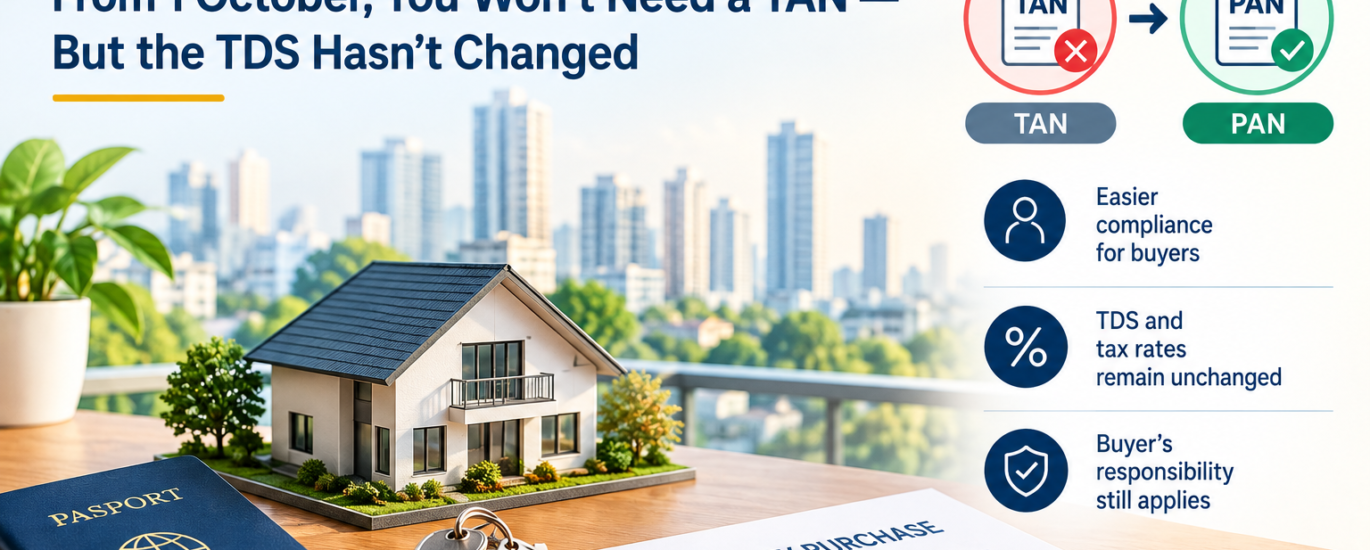
A new CBDT notification lets resident individuals and HUFs deduct and report TDS on purchases from non-resident sellers using just their PAN. The paperwork gets lighter. The tax, and the buyer’s responsibility for it, does not.
Buying a flat from a resident seller is, as far as TDS goes, fairly routine: deduct 1%, file a PAN-based form, done. Buying the same flat from an NRI has always been a different exercise. The buyer had to apply for a Tax Deduction Account Number (TAN), deduct tax at the rates that apply to non-residents, deposit it, and file a TDS return — all for what is, for most families, a one-time transaction. In practice, the TAN application was often the step that held up registration.
From 1 October 2026, that step goes. The CBDT has notified the Income-tax (Fifth Amendment) Rules, 2026, which allow resident individuals and HUFs buying immovable property from a non-resident to meet their TDS obligation through a PAN-based route.
What the Notification Actually Changes
The obligation itself sits in section 393(2) of the Income-tax Act, 2025 — in force from 1 April 2026 — which requires tax to be deducted on payments to a non-resident. What has changed is how an individual or HUF buyer complies with it.
Instead of a TAN and a separate TDS return, the buyer now uses Form 141, the unified challan-cum-statement for PAN-based TDS, which gets a new schedule specifically for purchases from non-residents. That schedule asks for:
- The property’s address and type
- Details of every buyer and seller, with PAN, and each seller’s share of the consideration
- The date of agreement, date of registration, stamp duty value and total sale consideration
- The amount and date of TDS, and whether the payment is a first, subsequent or final instalment
Where the non-resident seller has no PAN, the form asks for contact details, an overseas address, and the seller’s Tax Residency Certificate and Tax Identification Number where applicable. Tax deducted must be deposited within 30 days from the end of the month in which it is deducted. Where there are joint buyers, each files a separate form, and the TDS reported includes surcharge and cess.
What It Doesn’t Change
This is relief on procedure, not on tax — and that distinction is where most of the confusion in early coverage lies.
The ₹50 lakh threshold does not apply. The familiar rule — 1% TDS only where the consideration is ₹50 lakh or more — applies to resident sellers. Where the seller is a non-resident, TDS applies whatever the value of the property.
The rate is not 1%. Tax is deducted at the rate applicable to the seller’s capital gain: 12.5% on long-term gains, and slab rates on short-term gains, which in practice means the highest slab — in each case plus surcharge and 4% cess.
The liability is still the buyer’s. Short deduction or late deposit exposes the buyer, not the seller, to interest and penalty. A simpler form doesn’t dilute that.
What This Looks Like on an Actual Sale
Take an NRI selling a flat in Delhi for ₹1.20 crore that she bought in 2015 for ₹60 lakh — a long-term capital gain of ₹60 lakh.
Without anything more, the buyer has no way to verify her cost of acquisition, so the cautious course — and the common one — is to deduct on the full ₹1.20 crore. At 12.5% plus 15% surcharge and 4% cess, an effective rate of about 14.95%, that is roughly ₹17.94 lakh withheld.
If the seller has obtained a lower-deduction certificate from the Assessing Officer, computed on the gain, deduction is on ₹60 lakh at an effective rate of about 14.30% (with 10% surcharge): roughly ₹8.58 lakh.
Her final tax is the same either way; any excess is refunded once she files her Indian return. But in the first scenario, over ₹9 lakh of the sale proceeds stays with the tax department until that refund comes through — money she may have planned to repatriate or reinvest.
What Buyers Should Do Now
For a purchase that will close after 1 October:
- Confirm the seller’s residential status for the year of sale — don’t assume it from an address or a passport
- Collect the seller’s PAN or, failing that, overseas address, contact details, TRC and TIN
- Ask whether the seller holds a lower- or nil-deduction certificate, and deduct as it directs
- Work out TDS, including surcharge and cess, separately for each instalment
- If buying jointly, make sure each co-buyer files Form 141 for their own share
- Deposit within 30 days from the end of the month of deduction, and give the seller the TDS certificate
What NRI Sellers Should Do Before Signing
- Apply for a lower-deduction certificate early — ideally before the sale agreement, not after
- Keep the purchase deed, improvement bills and payment records ready to establish cost
- Obtain a current Tax Residency Certificate
- Plan the repatriation of proceeds, including the bank documentation it will need
- File the Indian return for the year to claim credit for the TDS and any refund
The Takeaway
Removing the TAN requirement takes away a real, and often pointless, obstacle for families making a one-time purchase from an NRI. But it removes a registration, not a responsibility. The buyer still has to deduct at the right rate, on the right amount, and report it accurately — now in more detail than before. For NRI sellers, the most useful step is unchanged: plan the TDS before the agreement is signed, because that is what decides how much of the sale price actually reaches you.
Samir Mahajan is a Chartered Accountant and Partner at Surinder Mahajan & Associates, where he advises NRI clients on cross-border tax compliance, property transactions, remittances, and estate and succession planning.