Dear Readers,
I hope you are doing well.
With the due date for filing Income Tax Returns approaching, NRIs should exercise greater caution while preparing the same. The Income Tax Department now relies extensively on technology-driven data matching through AIS, Form 26AS, banking information, property transactions, and other financial reporting systems.
Simple oversights—such as incorrectly determining residential status, failing to report interest on NRO accounts, claiming incorrect TDS credit, or overlooking capital gains—can result in automated tax notices, demands, or delays in processing refunds.
The article below highlights some of the most common mistakes made by NRIs while filing their Income Tax Returns and provides practical guidance to help ensure accurate compliance and avoid unnecessary tax disputes.
Warm regards,
Samir Mahajan
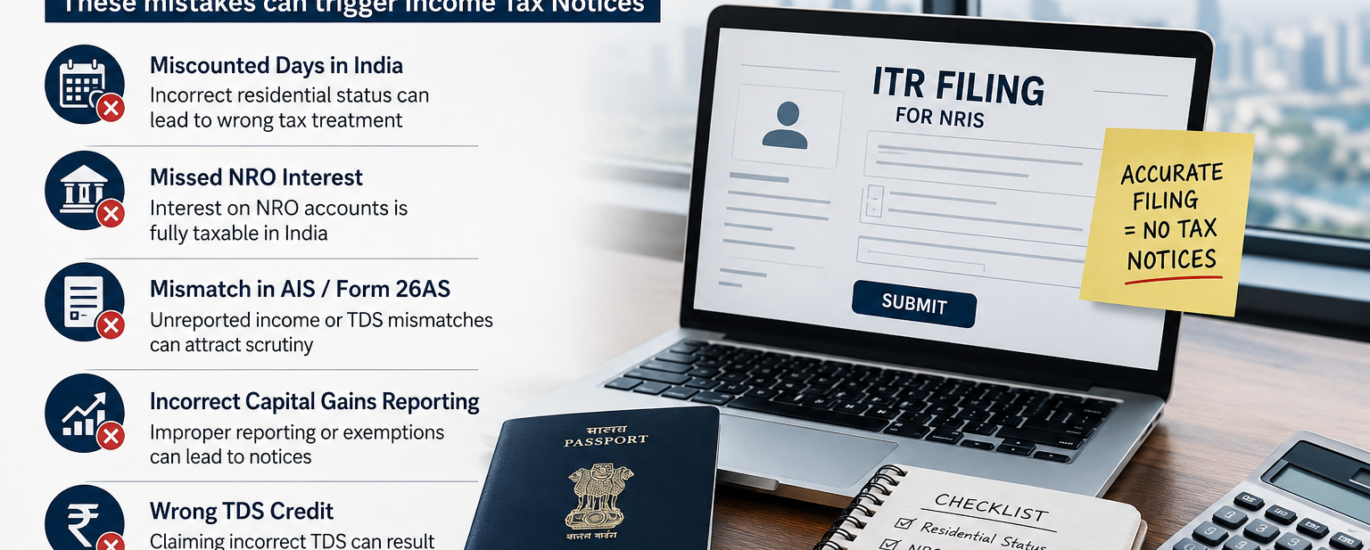
ITR Filing for NRIs: Common Mistakes That Can Trigger Income Tax Notices
With the Income Tax Department leveraging advanced data analytics, artificial intelligence, and real-time information from banks, financial institutions, registrars, and global reporting systems, even minor errors in an NRI’s Income Tax Return (ITR) can trigger automated notices.
To ensure hassle-free compliance, NRIs should avoid these common mistakes:
1. Incorrect Residential Status
Residential status is determined by the number of days spent in India — not merely by living or working abroad. An incorrect classification can lead to incorrect taxation and additional compliance requirements.
2. Not Reporting NRO Account Interest
Interest earned on an NRO account is taxable in India. Even if TDS has been deducted by the bank, the income must be reported in the ITR.
3. Not Reconciling AIS and Form 26AS
The Income Tax Department matches your return with data available in the Annual Information Statement (AIS), Taxpayer Information Summary (TIS), and Form 26AS. Any mismatch in interest income, dividends, capital gains, or TDS may invite scrutiny.
4. Incorrect Reporting of Capital Gains
Sale of property, shares, or mutual funds must be reported correctly after considering eligible deductions and exemptions. Many NRIs overlook this, assuming TDS deducted by the buyer is the final tax liability.
5. Claiming Incorrect TDS Credit
Always verify that TDS claimed in the return matches the credit reflected in Form 26AS. Incorrect claims often result in tax demands or processing adjustments.
6. Missing DTAA Benefits
Many NRIs end up paying higher taxes by not claiming relief available under the applicable Double Taxation Avoidance Agreement (DTAA) or Foreign Tax Credit (FTC). It’s important to note that this relief is not automatic — claiming it requires filing Form 10F along with a valid Tax Residency Certificate (TRC) from the country of residence. Missing this documentation is one of the most common reasons DTAA claims get disallowed or queried.
Key Takeaways
For NRIs, filing an income tax return is no longer a routine compliance exercise. With technology-driven verification and extensive data matching, accuracy has become critical.
Before filing your return, verify your residential status, reconcile AIS and Form 26AS, disclose all taxable income — including NRO interest — and correctly report capital gains and TDS. A well-prepared return not only minimizes the risk of tax notices but also ensures that eligible deductions, treaty benefits, and refunds are claimed without unnecessary litigation.
Samir Mahajan is a Chartered Accountant and Partner at Surinder Mahajan & Associates, where he advises NRI clients on cross-border tax compliance and remittances.