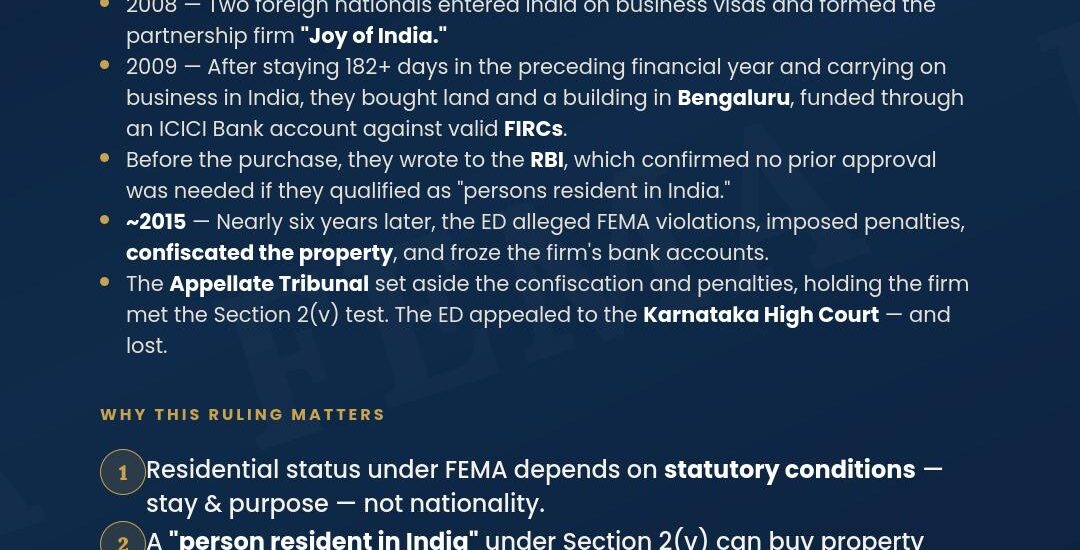
THE KARNATAKA HIGH COURT’S DEFINITIVE RULING
Case: Special Director, Directorate of Enforcement v. Joy of India Partnership Firm (2026) 187 Taxmann 603 (Karnataka High Court)
Dear Readers,
I hope you are doing well.
The legal framework governing property acquisition by foreign nationals in India has long been an area of uncertainty under the Foreign Exchange Management Act, 1999 (FEMA). Questions around residential status, RBI approvals, and the applicability of FEMA provisions have often led to prolonged litigation and enforcement action.
A recent judgment of the Karnataka High Court provides much-needed clarity. The Court reaffirmed that whether a person is a “person resident in India” under FEMA turns on the statutory conditions prescribed in the Act — not on nationality alone. The ruling also underscores the importance of proper documentation, transacting through authorized banking channels, and seeking regulatory clarification proactively.
This article examines the facts, the Court’s reasoning, and the practical implications for foreign nationals, NRIs, legal professionals, and businesses engaged in cross-border investment and property transactions in India.
Background
In 2008, two foreign nationals entered India on business visas and set up a partnership firm, Joy of India. The following year, they purchased land and a building in Bengaluru.
By the time of purchase, the partners had:
- Stayed in India for more than 182 days in the preceding financial year
- Carried on business activities in India
- Written to the RBI seeking clarification on the proposed purchase
- Received RBI confirmation that no prior approval was required if they qualified as “persons resident in India”
The property was funded through an ICICI Bank account using inward remittances backed by valid Foreign Inward Remittance Certificates (FIRCs). The firm also filed income tax returns regularly and held a PAN.
The Enforcement Directorate’s Case
Nearly six years after the purchase, the Enforcement Directorate (ED) initiated proceedings alleging FEMA violations. It imposed monetary penalties, ordered confiscation of the property, and froze the firm’s bank accounts — on the premise that, as foreign nationals, the partners required RBI approval before acquiring immovable property in India.
The Appellate Tribunal’s Findings
The Appellate Tribunal held that the purchasers met the statutory definition of “person resident in India” under Section 2(v) of FEMA, had lawfully acquired the property, and had committed no FEMA violation. It set aside the confiscation order and the penalties. The ED then appealed to the Karnataka High Court.
Issues Before the High Court
- Whether foreign nationals satisfying the requirements of Section 2(v) qualify as persons resident in India
- Whether prior RBI approval was necessary for the purchase
- Whether the ED was justified in confiscating the property and imposing penalties
The Karnataka High Court’s Reasoning
The Court affirmed the Tribunal’s decision and dismissed the ED’s appeal, on the following grounds:
1. Residential status is a question of statutory fact, not nationality
Section 2(v) looks to physical stay in India exceeding 182 days in the preceding financial year, together with the purpose and continuity of that stay — including whether the person is carrying on business or employment in India. The respondents satisfied both limbs and therefore qualified as persons resident in India, regardless of their foreign citizenship.
2. The RBI had already been consulted
The purchasers had proactively approached the RBI before the purchase, and the RBI confirmed that no separate approval was needed once the Section 2(v) test was met. The Court treated this as clear evidence of bona fide conduct and regulatory compliance.
3. The transaction was transparent and properly banked
Funds entered India through lawful banking channels, were supported by FIRCs, and the purchase consideration was paid in Indian Rupees. The Court found no evidence of foreign exchange manipulation.
4. Tax compliance reinforced legitimacy
The firm had obtained a PAN and filed income tax returns continuously from Assessment Year 2010–11 onward — further evidence that its operations were genuine and above board.
5. The ED could not produce its own records
Despite repeated opportunities, the Directorate of Enforcement failed to produce its original case records during the litigation. The Court took a dim view of this lapse in dismissing the appeal.
The Final Order
The Karnataka High Court dismissed the ED’s appeal, upheld the Tribunal’s findings, confirmed there was no FEMA violation, set aside the confiscation of the property, quashed the penalties, and closed the connected writ proceedings.
Why This Judgment Matters
- Residential status under FEMA is determined by statutory conditions — physical stay and purpose of residence — not by nationality alone.
- Foreign nationals who qualify as persons resident in India may acquire immovable property in accordance with FEMA, without separate RBI approval.
- Proactively seeking RBI guidance, and keeping a documented trail of that clarification, can be decisive in defending FEMA proceedings.
- Clean banking records, FIRCs, and consistent tax filings provide strong evidentiary support in enforcement matters.
- Enforcement action itself must be backed by proper records and sustainable evidence — a procedural failure by the ED can undo years of litigation.
Conclusion
The Joy of India Partnership Firm ruling is a significant precedent on the meaning of “person resident in India” under FEMA. It confirms that FEMA looks to the factual and legal status of residence, not citizenship alone, and it rewards parties who document their compliance carefully — proper banking channels, FIRCs, tax filings, and timely regulatory clarification.
For investors, businesses, and legal practitioners handling cross-border property transactions, the message is clear: compliance is built on statutory conditions and documentary evidence, and well-documented, transparent transactions can withstand even prolonged regulatory scrutiny.
Warm regards,
Samir Mahajan
Samir Mahajan is a Chartered Accountant and Partner at Surinder Mahajan & Associates, where he advises NRI clients on cross-border tax compliance and remittances.