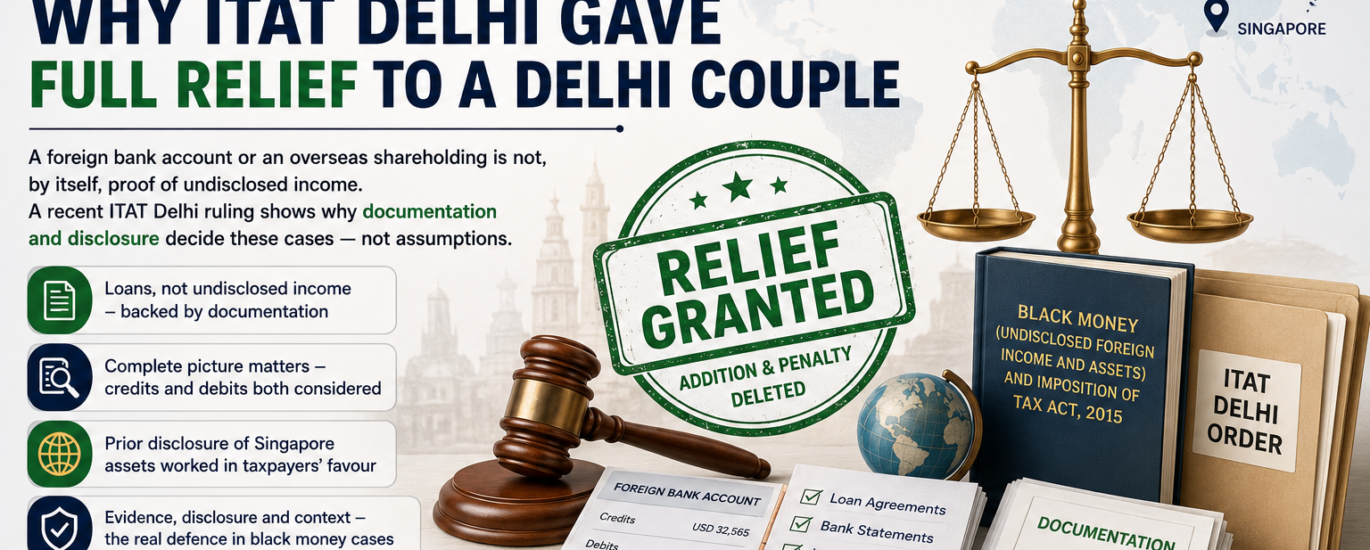
A foreign bank account or an overseas shareholding is not, by itself, proof of undisclosed income. A recent ITAT Delhi ruling shows why documentation and disclosure decide these cases — not assumptions.
Foreign assets and overseas bank accounts have come under increasing scrutiny from Indian tax authorities in recent years. But a recent ruling by the Income Tax Appellate Tribunal (ITAT), Delhi, is a reminder that merely having a connection with a foreign company or bank account does not automatically make the underlying money “black money.”
The case involved a Delhi-based couple, Nimit Rai Tiwari and Ankita Rai Tiwari, who faced tax additions of around ₹2.25 crore under the Black Money (Undisclosed Foreign Income and Assets) and Imposition of Tax Act, 2015. After a legal battle lasting nearly four years, the ITAT Delhi “H” Bench ruled in their favour, deleting both the additions and the consequential penalty.
What was the case about?
The Income Tax Department’s case centred on two overseas companies:
- Suncell Holdings SA (SHSA), registered in the British Virgin Islands (BVI)
- Sino Star Minerals Pte Ltd (SSMPL), incorporated in Singapore
The couple were nominee shareholders in SHSA, while Nimit Tiwari also held shares in SSMPL. SHSA maintained a bank account with BNP Paribas. The department treated certain credits appearing in these foreign bank accounts as undisclosed foreign assets and made additions totalling approximately ₹2.25 crore.
How did the taxpayers explain the money?
The couple’s position was that the major amounts credited to the foreign accounts were loans, not undisclosed income. To support this, they produced documentation including the lenders’ income-tax returns and bank statements.
The matter went back to the Assessing Officer for verification, who accepted that the lenders had the financial capacity to advance the loans. On that basis, the Commissioner of Income Tax (Appeals) — CIT(A) — deleted the bulk of the additions relating to these loan transactions.
One addition remained: a credit of approximately USD 32,565 in the SHSA bank account, of which the CIT(A) had treated 50% as commission income attributable to the taxpayers. This narrower issue is what eventually reached the ITAT.
Why did the ITAT delete the remaining addition?
Rather than looking at the disputed credit in isolation, the Tribunal examined the complete bank account. While the department’s case rested on the credit of roughly USD 32,565, the same account also carried debit entries totalling approximately USD 46,354.
Viewed as a whole, the account did not reflect the profit or income the tax authorities had assumed from the single credit entry. On this basis, the ITAT deleted the remaining addition — and since the addition itself did not survive, the consequential penalty fell away with it.
What about the Singapore assets?
A separate but important fact worked in the taxpayers’ favour: Nimit Tiwari’s shareholding in SSMPL, along with the company’s Singapore bank account, had already been disclosed in his income-tax return for AY 2016-17.
This mattered because the case was never simply about identifying a foreign asset — it was about whether that asset or income was genuinely undisclosed and could legally be taxed under the Black Money Act. Prior disclosure directly undercut the department’s position.
What can taxpayers learn from this case?
This ruling offers a practical checklist for anyone holding foreign investments, bank accounts, or interests in overseas companies.
Documentation matters. If a foreign bank credit represents a loan or another genuine transaction, be able to support it with loan agreements, bank records, the lender’s tax returns, and other corroborating evidence.
Disclosure is non-negotiable. Foreign assets and accounts that are required to be reported should be disclosed accurately and on time in the income-tax return. Prior, voluntary disclosure is one of the strongest defences available.
Transactions must be viewed in context. A tax authority cannot reasonably determine taxable income by isolating a single credit entry while ignoring related debits or the broader financial picture.
A foreign connection alone doesn’t equal undisclosed income. The nature of the asset, the ownership structure, the source of funds, and the supporting evidence all matter — and all need to be examined together.
The bigger picture
The Black Money Act gives tax authorities significant powers to deal with undisclosed foreign assets, and rightly so — the compliance bar for foreign holdings is high. But this ITAT ruling reinforces an equally important principle: tax liability must be supported by evidence and the actual facts of the transaction, not by assumption.
For taxpayers with legitimate foreign assets or transactions, the message is straightforward: keep your disclosures accurate and your paperwork in order. When questions arise — and increasingly, they will — good documentation is often what makes the difference between a prolonged dispute and a clean resolution.
If you hold overseas bank accounts, foreign company shareholdings, or other cross-border assets and want a compliance check against current disclosure requirements, our team can help you review your position before it becomes a question from the tax department.
Disclaimer: This article is for general informational purposes only and should not be treated as tax or legal advice. The outcome of any tax matter depends on its specific facts and applicable law.
Samir Mahajan is a Chartered Accountant and Partner at Surinder Mahajan & Associates, where he advises NRI clients on cross-border tax compliance and remittances.