Dear Readers,
I hope you are doing well.
For NRIs, Income Tax Return (ITR) filing in India involves much more than reporting income. Choosing the correct ITR form, determining taxable income, claiming TDS credits, and ensuring proper compliance are essential to avoid notices, refund delays, and unnecessary tax disputes.
This article provides a practical overview of key aspects of NRI taxation, including taxable income in India, selection of ITR-2 versus ITR-3, tax regime considerations, TDS refunds, and important reporting requirements. A clear understanding of these provisions can help NRIs file accurate returns, maximize eligible refunds, and remain tax compliant.
Warm regards,
Samir Mahajan
Chartered Accountant
NRI ITR Filing in India: Taxable Income, ITR-2 vs ITR-3, TDS Refunds and Key Compliance Requirements
Introduction
Filing an Income Tax Return (ITR) in India as a Non-Resident Indian (NRI) involves more than merely reporting income. Selecting the correct ITR form, identifying taxable income, claiming eligible TDS credits, and ensuring proper compliance are critical to avoid notices, refund delays, and reporting errors.
This article highlights the key tax and compliance considerations every NRI should review before filing an Indian tax return.
1. Choosing the Correct ITR Form
The applicable ITR form depends upon the nature of income earned in India.
| Income Source | Applicable ITR |
| Bank Interest, Dividend Income, Capital Gains, Rental Income | ITR-2 |
| Intraday Trading, F&O Trading, Business Income, Professional Income | ITR-3 |
NRIs should generally avoid filing ITR-1 or ITR-4, as these forms are not intended for non-resident taxpayers.
2. What Income is Taxable in India?
As a general rule, income that accrues, arises, or is received in India is taxable in India for NRIs.
Taxable Income
- Interest earned on NRO accounts
- Capital gains from Indian shares and mutual funds
- Dividend income from Indian companies
- Rental income from property situated in India
Generally Exempt / Non-Taxable Income
- Foreign salary earned and received outside India
- Foreign income earned outside India
- Interest earned on NRE deposits
- Interest earned on FCNR deposits
3. Old vs New Tax Regime – Which is Better?
A crucial point often overlooked by NRIs is that they are not eligible for the rebate under Section 87A.
Therefore, taxpayers should compare their tax liability under both regimes before filing their return.
Old Tax Regime
- Deductions available under Sections 80C, 80D and other eligible provisions.
- Suitable where significant deductions are available.
New Tax Regime
- Lower slab rates.
- Limited deductions and exemptions.
The most tax-efficient regime should be selected after evaluating the overall tax impact.
4. Important Reporting Requirements
NRIs should ensure accurate reporting of:
- Residential Status as Non-Resident
- Interest and Dividend Income
- Capital Gains from Shares and Mutual Funds
- Rental Income from Indian Properties
- Virtual Digital Asset (Crypto) Transactions, wherever applicable
- Exempt Income such as NRE and FCNR Interest
Before filing the return, taxpayers should also update their residential status on the Income Tax Portal profile to ensure consistency in reporting.
5. TDS Refunds and Bank Account Validation
Many NRIs face excess TDS deductions on interest income, dividends, rent, and capital gains. Such excess taxes can be claimed as a refund through the ITR.
Before filing, taxpayers should:
- Verify TDS credits appearing in Form 26AS
- Review income reported in AIS
- Reconcile discrepancies, if any
- Validate bank account details for refund processing
A validated NRO bank account is generally used for receiving income tax refunds.
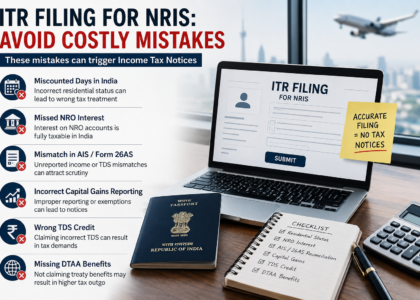
Common Mistakes to Avoid
- Filing the wrong ITR form
- Incorrect determination of residential status
- Non-reporting of taxable Indian income
- Ignoring mismatches in AIS or Form 26AS
- Failure to claim available TDS credits
- Non-validation of bank account details
- Selecting a tax regime without proper comparison
Conclusion
For most NRIs, tax compliance is not merely about filing a return—it is about filing the right return. Correct selection of ITR-2 or ITR-3, accurate reporting of Indian income, proper reconciliation of tax credits, and timely filing can help avoid disputes and facilitate faster refund processing.
A well-prepared return not only ensures compliance with Indian tax laws but also improves tax efficiency and minimizes future litigation and tax risks.